Overprovisioning is the default
Compute, databases, and Kubernetes requests get sized for a peak that rarely comes, then never revisited. Every new workload starts oversized and stays that way.
Product · Cloud optimization
The Analyzer Agent continuously scans compute, databases, and storage across every connected account and turns what it finds into a ranked, dollar-quantified action, delivered as a PR-ready Terraform diff or a guided ClickOps runbook.
Rightsizing & Spot Storage lifecycle Idle & non-prod cleanup
Why savings don't stick
Over-provisioning isn't a one-time mistake. It's the default state of a growing cloud estate. Without continuous monitoring, it always finds a way back in.
Compute, databases, and Kubernetes requests get sized for a peak that rarely comes, then never revisited. Every new workload starts oversized and stays that way.
Dev environments on weekends, unattached storage, forgotten endpoints: invisible until someone goes looking, and nobody's job is to look.
A point-in-time cleanup resets the meter, but new workloads launch oversized and defaults regress. Without continuous monitoring, spend drifts back within a year.
What gets found
The Analyzer Agent continuously scans compute, databases, and storage across every connected account and turns what it finds into a ranked action, not just a chart.
Every resource gets a concrete recommended action: rightsize, migrate to Graviton, move to Spot, scale in, or delete, each with a dollar-savings estimate attached, so prioritization is a sort, not a guess.
Every recommendation moves through a status pipeline: Discovered, In Progress, Completed, so your team can see what's been actioned versus what's still open, instead of losing findings in a spreadsheet.
Each recommendation states the implementation effort, whether a restart is required, whether it's rollback-safe, the exact affected resource IDs, and the evidence behind it: the detail an engineer actually needs before touching production.
Recommendations are written in natural language: why a database migration saves money, current vs. target instance specs, remaining capacity headroom, not just a raw metrics dump.
Two of those recommendations, end to end:
Savings proof
of total spend lost to drift by month 12 without continuous optimization
recovered continuously on a $100K/mo cloud bill
downside risk: if verified savings fall short of our fee, we credit the difference
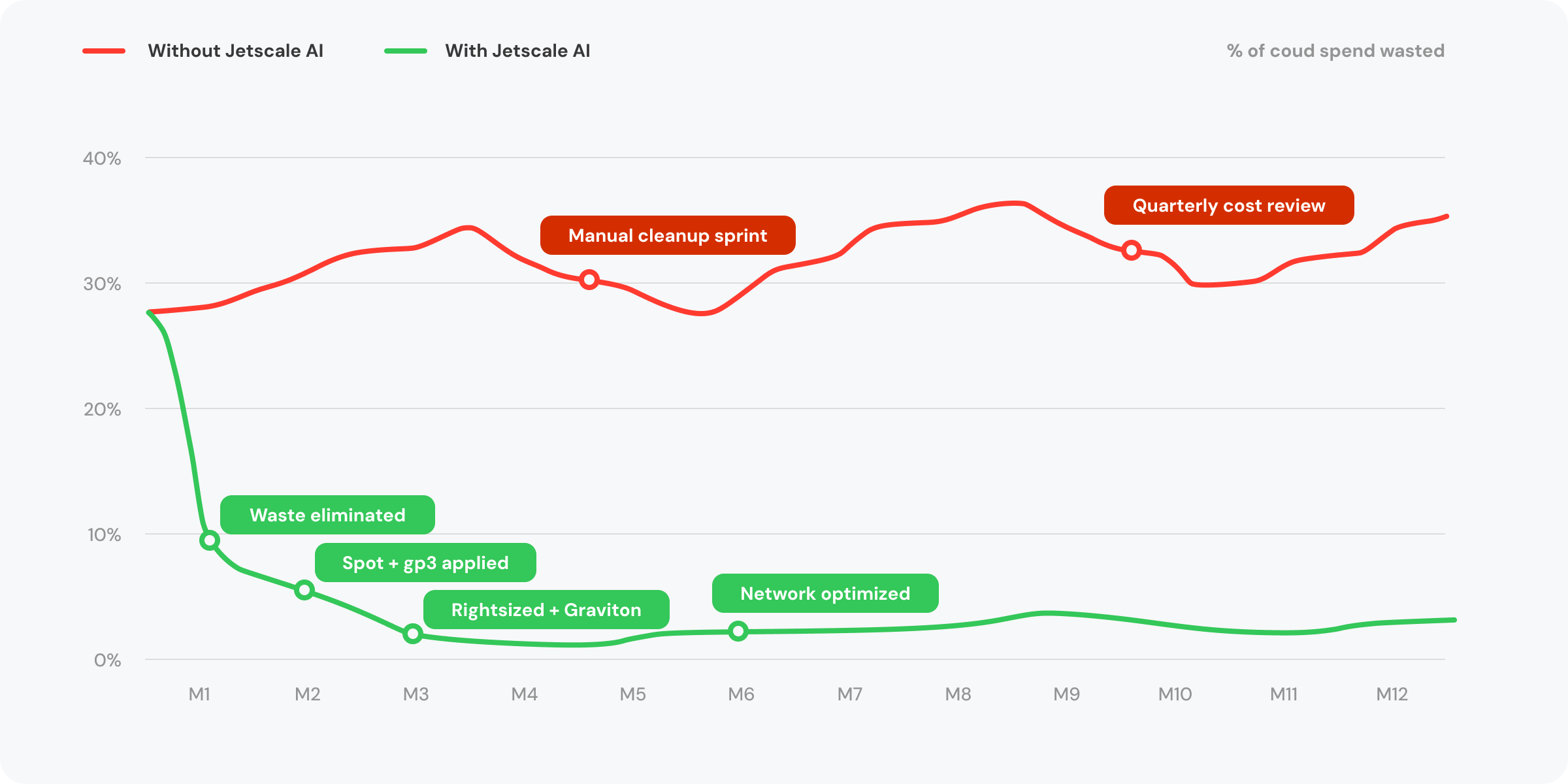
Drift figures from Jetscale's compounding-drift model. See Why Jetscale for the breakdown.
Get started
Read-only connection. Evidence-backed findings. PR-ready fixes. Self-funded, with guaranteed ROI.